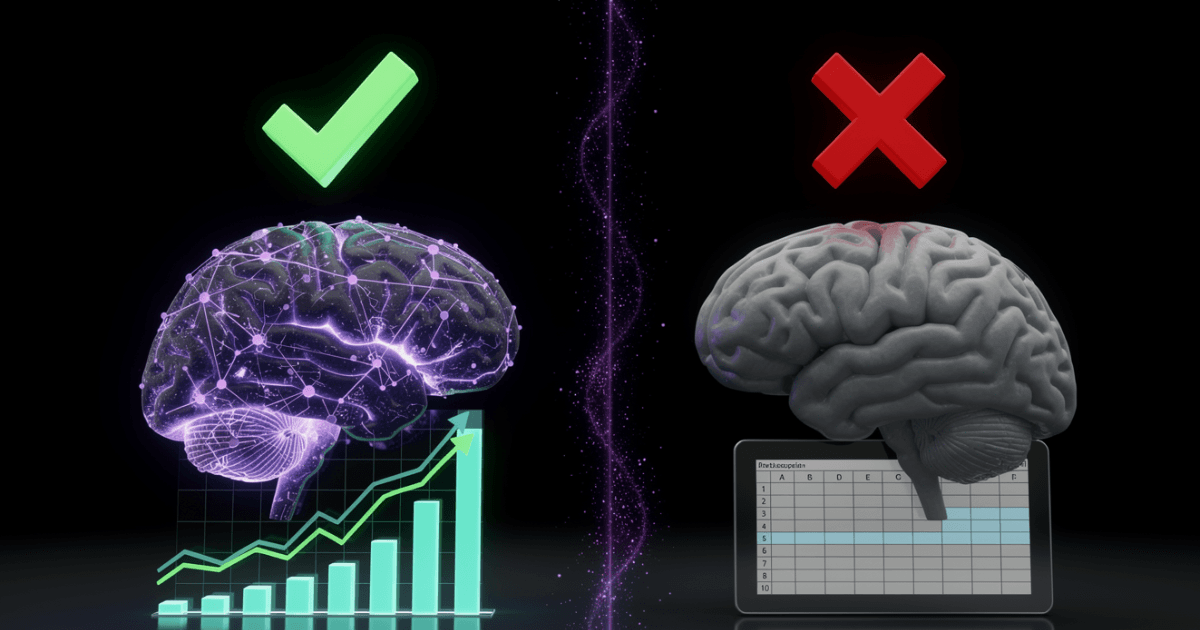
The hype vs. reality gap
Every vendor is selling AI. Every pitch deck mentions it. But most businesses don't need a custom large language model — they need their existing processes to work better.
The question isn't "should we use AI?" It's "where does AI create the most value with the least risk?"
When AI makes sense
Repetitive pattern recognition. If your team spends hours reviewing documents, categorizing support tickets, or flagging anomalies in data — AI handles that faster and more consistently.
Natural language processing. Customer support chatbots, document summarization, contract analysis, and content generation are all strong use cases. LLMs are exceptionally good at understanding and generating text.
Prediction from historical data. Demand forecasting, churn prediction, pricing optimization — if you have clean historical data and a clear target metric, predictive models deliver measurable ROI.
Automation of manual workflows. Data entry, report generation, invoice processing — any task that follows a pattern and takes human time can often be automated with AI.
When AI doesn't make sense
You don't have data. ML models need training data. If you're starting from zero, the first step is building a data pipeline — not an AI system.
The problem is simple. If a set of business rules can solve the problem, write business rules. AI adds complexity. Only add that complexity when simpler approaches fall short.
You can't define success. AI needs a measurable outcome. "Make things better" isn't a goal. "Reduce support response time by 40%" is.
Accuracy requirements are absolute. AI is probabilistic. If a 2% error rate is unacceptable (medical diagnosis, financial compliance), AI should assist humans — not replace them.
Our approach
At DSX, we start every AI engagement with a problem-framing session. We ask:
- What's the business problem?
- What data do you have?
- What does success look like?
- What happens when the AI is wrong?
If AI is the right tool, we build a proof of concept in 2–4 weeks against real data. If it's not, we'll tell you — and suggest what will actually work.
Start with the problem, not the technology
The best AI projects start with a clear business need and end with measurable results. The worst start with "we should do something with AI" and end with an expensive experiment that nobody uses.
We build AI that works. That means saying no to projects where AI isn't the right answer — and saying yes to the ones where it is.
Have a process that might benefit from AI? Let's evaluate it together.